Label and draw points, line segments, rays, and lines. Draw, describe, and classify angles. Use a protractor to measure angles and identify right angles, straight angles, acute angles, obtuse angles, and reflex angles.
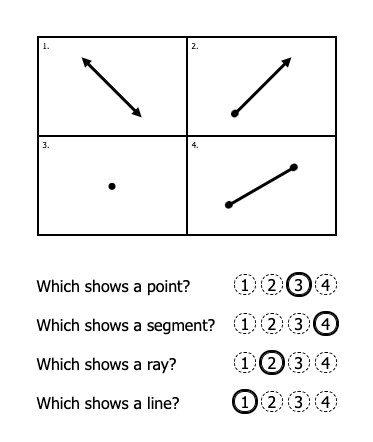
Identify and draw points, line segments, rays, and lines. A point is the smallest part of a line. A line segment connects 2 points. Its length is the distance between the points. A ray starts at a point and extends forever in 1 direction. A line extends forever in opposite directions. The length of a point, ray, or line can't be measured.
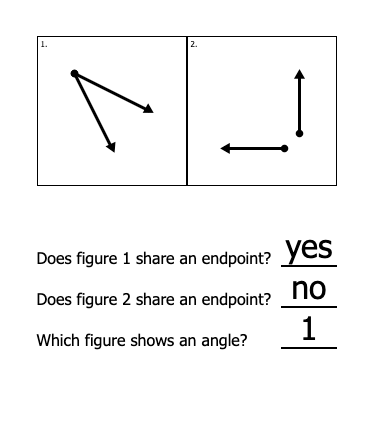
Form angles using 2 rays that share a common endpoint. Describe and classify angles informally as "sharp" (acute), "wide" (obtuse), and "square" (right). Transition to formal names when students can measure angles in degrees with a protractor. Draw sharp, wide, and square angles, as well as figures that are not angles. Prerequisites: 4-128
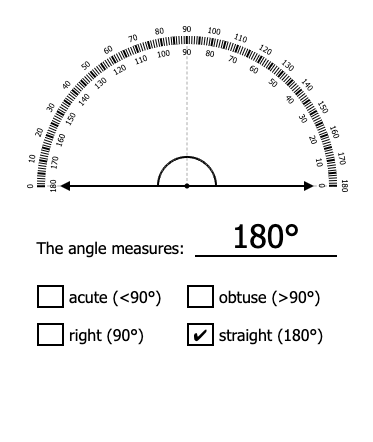
Measure angles using a protractor. Classify by comparing angles to 90° right angles formed by perpendicular rays, and 180° straight angles formed by rays pointing in opposite directions. An angle less than 90° is an acute angle. An angle between 90° and 180° is an obtuse angle. A reflex angle is between 180° and 360°. Prerequisites: 4-129