Calculate with mixed numbers. Apply previous experiences with number bonds and shifting 10 to working with mixed numbers. Add and subtract mixed numbers with no regrouping, with regrouping, and with unlike denominators.
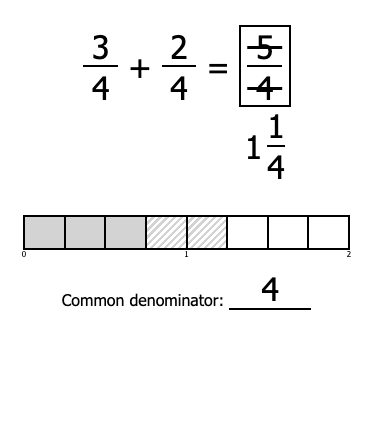
Transition to adding 2 fractions with equal denominators and sums greater than 1. What's 3/4 + 2/4? Their units are the same – they have common denominators – so add their quantities or numerators. 3 fourths + 2 fourths = 5 fourths, or 1 and 1 fourth. Using fraction notation, 3/4 + 2/4 = 5/4 = 4/4 + 1/4 = 1 1/4. Prerequisites: 4-98
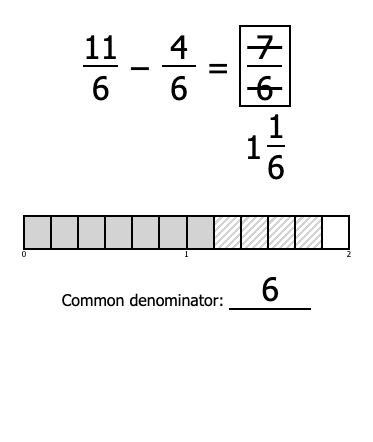
Transition to subtracting 2 fractions with equal denominators and differences greater than 1. What's 11/6 - 4/6? Their units are the same – equal denominators – so subtract their quantities or numerators. 11 sixths - 4 sixths = 7 sixths, or 1 and 1 sixth. Using fraction notation, 11/6 - 4/6 = 7/6 = 6/6 + 1/6 = 1 1/6. Prerequisites: 4-100 ○ 4-86
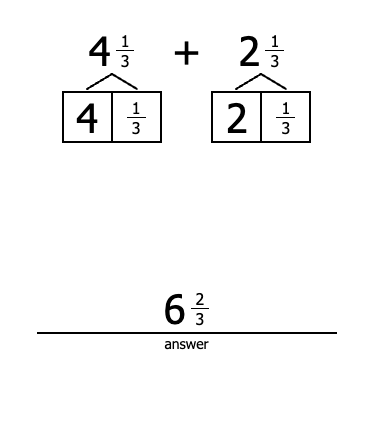
Add and subtract mixed numbers with common denominators. What's 4 1/3 + 2 1/3? Use partial sums to add. Since 4+2 = 6 and 1/3 + 1/3 = 2/3, the sum is the mixed number 6 2/3. What's 4 6/8 - 2 1/8? Use partial differences to subtract. Since 4-2 = 2 and 6/8 - 1/8 = 5/8, the difference is the mixed number 2 5/8. Prerequisites: 4-100, 4-98