Find the difference between two decimal numbers. Shift ones or tenths as needed, use partial differences and then the standard algorithm. Compare digits in decimal numbers additively.
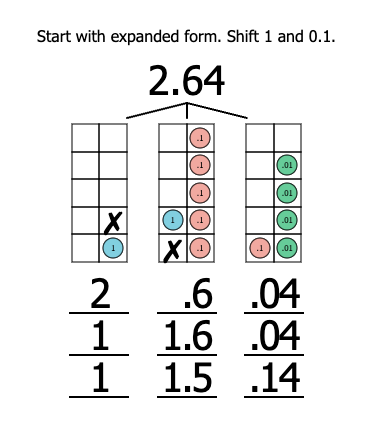
Prepare for regrouping by shifting ones and tenths. What's 2.64 if 1 one and 1 tenth are shifted? Shift 1 one. 2 ones become 1 one, and 6 tenths become 16 tenths. Shift 1 tenth. 16 tenths become 15 tenths, and 4 hundredths become 14 hundredths. 2.64 = (1 x 1)+(15 x .1)+(14 x .01) = 1 + 1.5 + .14 Prerequisites: 4-119
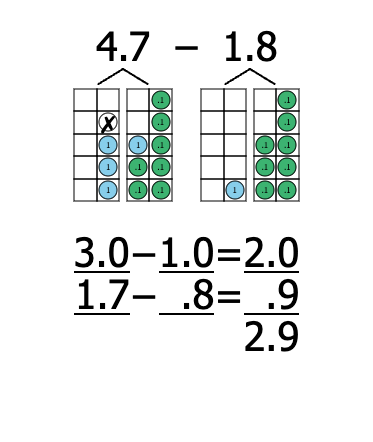
Model and subtract ones, tenths, and hundredths using Base 10 discs and number bonds. What's 4.7 - 1.8? To get more tenths, shift 1 to get 3 ones and 17 tenths. Since 3 - 1 = 2 and 1.7 - .8 = .9, 4.7 - 1.8 = 2 + .9 = 2.9. Lay the foundation for vertical algorithms by regrouping and subtracting units that are the same. Prerequisites: 5-100
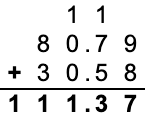
Add and subtract using vertical, standard algorithms that focus on each digit's quantity and place value. What's .09 + .08? 9 hundredths + 8 hundredths = 17 hundredths = 1 tenth + 7 hundredths. Write a "7" in the hundredths place and a "1" in the tenths place. Write digits in the correct column with the correct place value. Prerequisites: 5-101, 5-99 ○ 4-32