Subtract 3-digit numbers by shifting 10, 100, or 10 and 100, before calculating partial differences. Solve problems subtracting across double zeros, an equal number of tens, or zero tens.
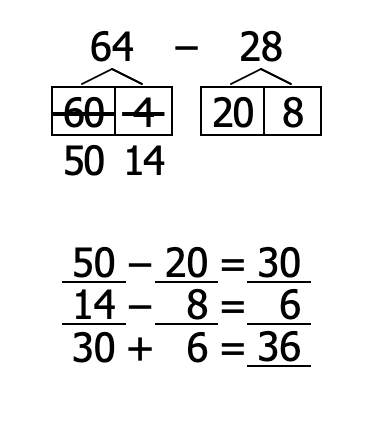
Transition from using concrete Base 10 discs to model regrouping problems, to using pictorial number bonds. What's 64–28? 64 in expanded form is 60 and 4. 28 is 20 and 8. There are not enough ones, so shift 10. "Sixty-four" becomes "fifty-fourteen." Since 50-20 = 30, 14-8 = 6, and 30+6 = 36, 64-28 = 36. Prerequisites: 2-34 ○ 1-103
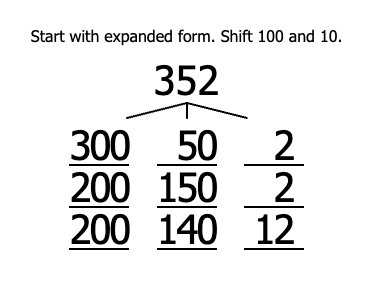
Transition from Base 10 blocks to using number bonds to model numbers and shift 100 and 10. What's 352? It's 3 hundreds, 5 tens, and 2 ones, or 300+50+2. Shift 100. It's 200+150+2. Now shift 10. It's 200+140+12. Start by writing 3 number bonds. With practice, mentally shift 100 and 10 and write the final number bond. Prerequisites: 2-81
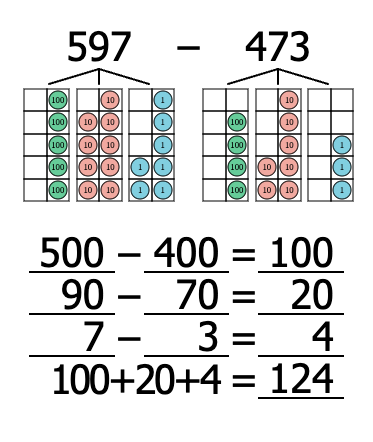
Use Base 10 discs to subtract 3-digit numbers with no regrouping. What's 597-473? Subtract same units – hundreds, tens, and ones. 500-400 = 100, 90-70 = 20, and 7-3 = 4. Add the 3 partial differences to get the total difference. Since 100+20+4 = 124, 597-473 = 124. Transition to number bonds and equations. Prerequisites: 2-99