Introduce multiplication as equal groups, using bar models and arays. Systematically study 0-1, 2-3, 4, and 5 groups of 1-9. Break apart groups rather than skip-count, and use number bonds and equations to build fluency.
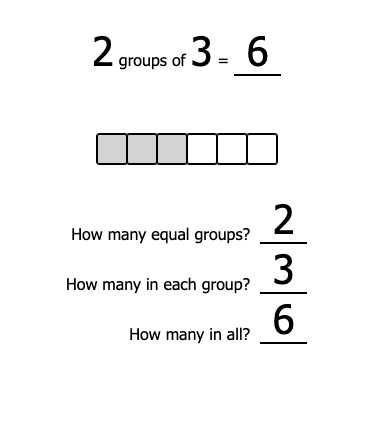
Use snap cubes to model equal groups. Represent values by the number and length of cubes snapped together. Focus on seeing, hearing, and understanding the difference between the number of groups and the number in each group – the size of each group. Add in smart ways to figure out how many in all – the total.
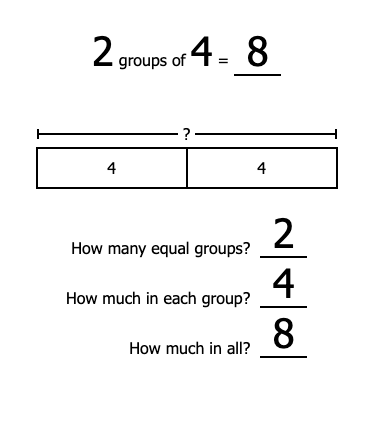
Use bar models to model equal groups. Represent values by the lengths of bars. To draw equal groups, draw a shorter bar and make copies. Alternatively, draw a longer bar and divide it into equal lengths. Draw halves to make 2 equal groups. Divide each half in half to make 4 equal groups. Visually estimate 3 and 5 equal groups. Prerequisites: 2-17
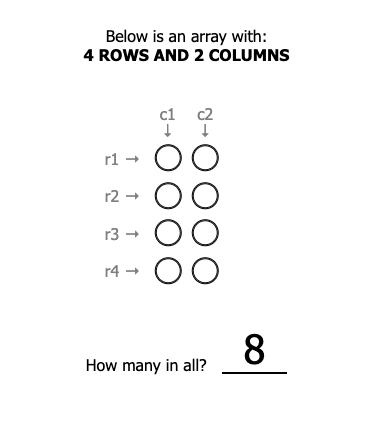
Color or draw an array with up to 5 rows and 5 columns of circles or dots. Use the convention that the number of rows represents the number of groups, and the number of columns represents the size or number in each group. An array with 4 rows and 2 columns is 4 groups of 2. Since 2+2+2+2 = 8, the array has 8 circles in all. Prerequisites: 2-18