Remove or separate a part from the total to find the value of the remaining part. Count backward, find the unknown part and subtract by subitzing, to build fluency and find how many are left.
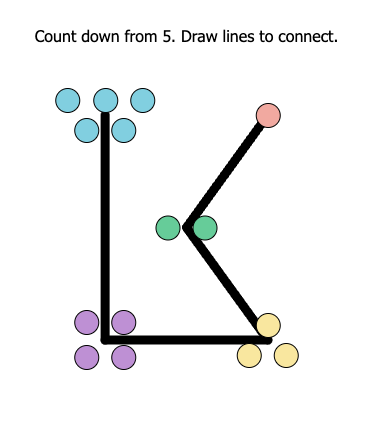
Count backward to deepen understanding of numbers 1 to 5 while laying the groundwork for subtraction. What number is 1 less and comes before 5? 4. What number is 1 less and comes before 4? 3. Put numbers represented visually in groups and abstractly with digits in descending or reverse order. Prerequisites: K-22
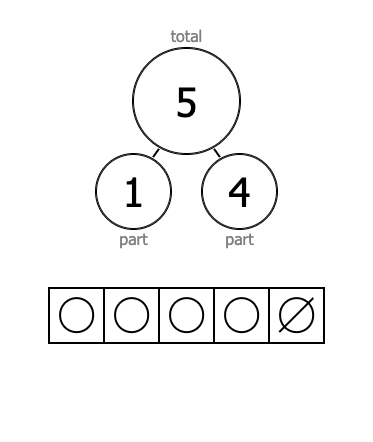
Introduce subtraction as "take away". Given the total and one of the parts on a number bond, find the other part. If the total is 5 and 1 is taken away, how many are left? Start by visualizing 5 on a five frame. Mentally cross off 1. How many are left? Draw or use counters to check that the answer is 4. Prerequisites: K-30 ○ K-29, K-27, K-26
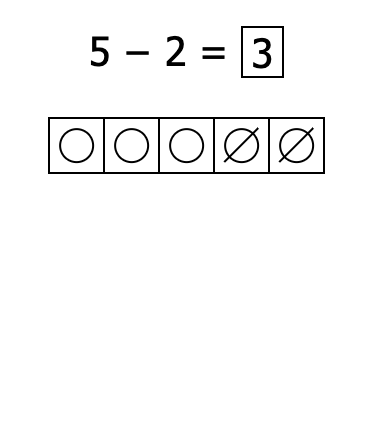
Introduce subtraction equations as a more formal and abstract way to show the relationship between a total and its parts. Combine all 3 models – concrete five frames, pictorial number bonds, and abstract equations – to make connections and help students see that the total minus one of the parts leaves the other part. Prerequisites: K-41 ○ K-32, K-26