Break dividends into easier-to-divide multiples of hundreds, tens, and ones, using the partial quotients algorithm. This methoid maintains place value and is a bridge to the more abstract long division algorithm.
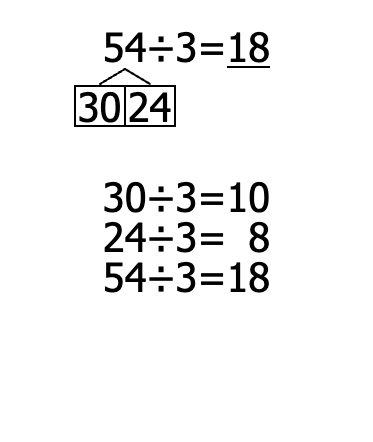
Use number bonds and mental math to solve division regrouping problems fluently. What's 54÷3? 54 = 50+4, but neither 50 nor 4 are multiples of 3. Regroup by shifting 10 twice – shifting 20 in all – to make 30 and 24. Since 30÷3 = 10, 24÷3 = 8, and 10+8 = 18, 54÷3 = 18. Find and add partial quotients to get the total quotient. Prerequisites: 3-111 ○ 3-71
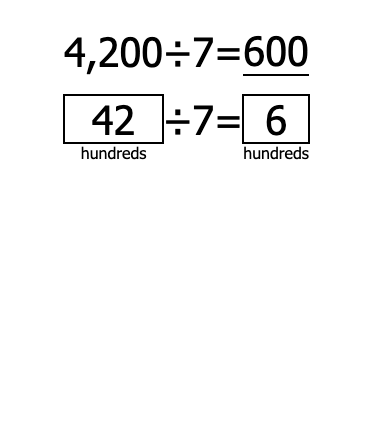
Divide a multiple of 100 by a single-digit number by thinking in units of 100. What's 4,200 ÷ 7? 4,000 = 40 hundreds and 200 = 2 hundreds, so 4,200 = 42 hundreds. 42 hundreds ÷ 7 = 6 hundreds = 600. Think of "00" as hundreds. What's 2,400 ÷ 3? 2,400 = 24 hundreds, and 24 hundreds ÷ 3 = 8 hundreds = 800. Prerequisites: 3-109
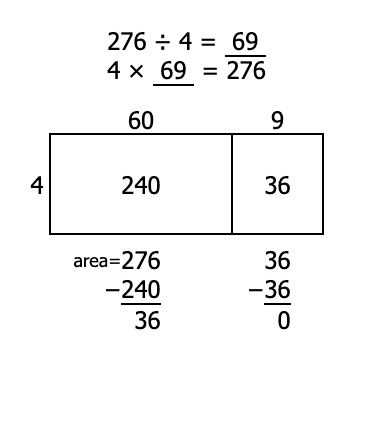
Divide using area models. What's 276÷4? Draw a rectangle with area 276 and short side of 4. What's the other side? 4 x __ = 276? Break the total area into partial areas. 276 = 240+36, so 276÷4 = (240÷4) + (36÷4). Since 4x60 = 240 and 4x9 = 36, 276÷4 = 60+9 = 69. Find and add partial quotients to get the total quotient. Prerequisites: 4-12 ○ 4-12